A four-year-old watches her friend trip on the playground and scrape his knee. Instead of running off to continue playing, she stops, walks over, and offers her favorite stuffed animal for comfort. This small moment represents something profound: the early emergence of empathy, one of the most important social-emotional skills a child can develop.
Teaching empathy in the preschool years isn’t just about raising kind children, though that matters enormously. Research from the University of Cambridge shows that children who develop strong empathetic abilities by age five demonstrate better academic performance, healthier relationships, and lower rates of anxiety and depression well into adulthood. The neural pathways forming during these early years create the foundation for how children will connect with others throughout their lives.
But here’s what many parents and educators miss: empathy isn’t a single skill that children either have or don’t have. It’s a complex interplay of cognitive development, emotional awareness, and learned behaviors that can absolutely be nurtured and strengthened. The preschool years, roughly ages three to five, represent a critical window when children’s brains are uniquely primed for this learning. Their rapid neural development, combined with their natural curiosity about others, creates an ideal environment for empathy education.
The good news? You don’t need expensive programs or complicated curricula. The most effective empathy teaching happens through everyday moments, intentional modeling, and simple activities that fit naturally into daily routines.
The Foundations of Empathy in Early Development
Understanding how empathy develops helps caregivers meet children where they are rather than expecting responses beyond their developmental capacity. Preschoolers aren’t miniature adults with fully formed emotional processing abilities. Their brains are still constructing the architecture that makes mature empathy possible.
Cognitive vs. Affective Empathy in Toddlers
Developmental psychologists distinguish between two types of empathy that emerge at different stages. Affective empathy, the ability to feel what another person feels, appears first. You’ve likely seen this when a toddler cries upon hearing another child cry, even without understanding why that child is upset.
Cognitive empathy, the ability to understand another person’s perspective and mental state, develops later and more gradually. This is why a three-year-old might offer her crying mother a pacifier: she’s responding to distress but hasn’t yet developed the cognitive capacity to understand that adults need different comfort than babies do.
By age four, most children begin showing signs of both types working together. They can recognize that someone feels sad and start to understand why, even if the reason differs from what would make them sad. This cognitive shift is crucial for teaching empathy in the preschool years because it means children can now learn to consider perspectives beyond their own.
The Role of Mirror Neurons and Brain Growth
The biological basis for empathy involves specialized brain cells called mirror neurons. These neurons fire both when a child performs an action and when they observe someone else performing that same action. When your preschooler watches you stub your toe and winces sympathetically, mirror neurons are at work.
Research from Vanderbilt University has shown that the prefrontal cortex, responsible for emotional regulation and perspective-taking, undergoes massive development between ages three and six. This brain region helps children move beyond automatic emotional responses toward more thoughtful, regulated empathetic behavior. Activities that strengthen this area, such as games requiring turn-taking or stories asking children to predict characters’ feelings, directly support empathy development.
Modeling Empathetic Behavior as a Caregiver
Children learn empathy primarily through observation. They watch how the adults in their lives respond to others’ emotions, handle conflict, and express care. This modeling happens constantly, whether we’re aware of it or not.
The Power of Leading by Example
Your preschooler notices when you thank the grocery store clerk warmly or when you snap at them impatiently. They observe how you respond when a neighbor shares difficult news or when a family member makes a mistake. These observations form their internal template for how people treat each other.
Intentional modeling means being conscious of these moments. When you see someone struggling with heavy bags, narrate your thinking: “That person looks like they could use help. Let’s ask if we can hold the door.” When you feel frustrated with a slow driver, you might say, “I’m feeling impatient right now, but maybe that person is having a hard day.”
This isn’t about performing perfection. Children actually benefit from seeing you make mistakes and repair them. When you lose your temper and then apologize, you’re modeling both that adults have big feelings too and that relationships can be mended.
Using ‘I’ Statements to Express Feelings
One of the most practical tools for modeling empathy is consistent use of “I” statements that name emotions. Instead of “You’re being so loud,” try “I feel overwhelmed when there’s a lot of noise.” Instead of “That was mean,” try “I felt hurt when that happened.”
This language does two things simultaneously. It demonstrates healthy emotional expression, showing children that feelings are normal and can be communicated. It also teaches the vocabulary children need to identify and express their own emotions, a prerequisite for recognizing those same emotions in others.
Practical Activities to Build Emotional Intelligence
While modeling provides the foundation, structured activities give children opportunities to practice empathetic thinking in low-stakes situations. The best activities feel like play while building crucial skills.
Storytelling and Perspective-Taking Games
Books offer perfect opportunities for empathy practice because characters’ emotions can be discussed without anyone feeling defensive. Choose stories with clear emotional content and pause frequently to ask questions: “How do you think the bunny feels right now? What makes you think that? Have you ever felt that way?”
The key is moving beyond identification toward understanding. After a child says a character feels sad, ask follow-up questions: “What happened that made her sad? What might help her feel better? What would you do if your friend felt this way?”
Create your own stories featuring your child’s stuffed animals or action figures facing emotional dilemmas. A teddy bear whose friend won’t share, a dinosaur who feels left out at a party, a doll who accidentally broke something important. These scenarios let children practice perspective-taking with beloved characters.
Identifying Emotions Through Visual Aids
Preschoolers are still building their emotional vocabulary. Visual aids help them connect internal feelings with recognizable external expressions. Emotion cards showing faces with different expressions can become sorting games, matching activities, or conversation starters.
Create an “emotion thermometer” for your home, a visual scale showing feelings from calm to very upset. Check in throughout the day: “Where are you on the thermometer right now?” This builds self-awareness while normalizing emotional fluctuation.
Photo albums showing family members expressing various emotions help children recognize that the same person can feel many different ways. “Look, here’s Grandma laughing at your birthday party. And here she looks tired after our long hike.”
Role-Playing Social Scenarios
Puppets, dolls, and stuffed animals provide emotional distance that helps preschoolers explore difficult scenarios. Act out common situations: a toy being grabbed, someone feeling left out, a friend getting hurt. Then switch roles so children experience multiple perspectives.
Keep scenarios simple and relevant to your child’s life. A puppet who doesn’t want to share the blocks, a stuffed animal whose tower got knocked down, a doll who feels scared on the first day at a new playground. Ask children to suggest solutions and discuss how each character might feel about different outcomes.
Nurturing Compassion Through Daily Interactions
The most powerful empathy teaching happens not in structured activities but in the countless small moments throughout each day. These interactions shape children’s understanding of how caring relationships work.
Encouraging Acts of Kindness and Sharing
Rather than forcing sharing, which often backfires, create opportunities for children to experience the positive feelings that come from generosity. “Would you like to bring cookies to our neighbor who’s been sick? I think it might make her smile.”
Notice and name kind behaviors when they occur naturally. “I saw you give Marcus the red crayon because you knew it was his favorite. That was thoughtful.” This specific feedback helps children connect their actions with positive outcomes.
Involve preschoolers in family helping rituals: making cards for relatives, choosing toys to donate, helping prepare food for a new parent in the neighborhood. These activities make kindness concrete and habitual rather than abstract.
Validating the Child’s Own Emotions First
Here’s something counterintuitive: children struggle to show empathy when their own emotional needs aren’t being met. A child who feels dismissed or misunderstood will have difficulty extending understanding to others.
When your preschooler has big feelings, resist the urge to minimize or fix immediately. “You’re really disappointed that we can’t go to the park today. That’s hard when you were looking forward to it.” This validation teaches children that emotions are acceptable and manageable, making them more comfortable recognizing emotions in others.
Laura Berk’s research on emotional development emphasizes that children who experience empathetic responses from caregivers develop stronger empathetic capacities themselves. Your attunement to your child’s emotional states becomes their template for attunement to others.
Navigating Conflict and Building Social Skills
Conflict between preschoolers is inevitable and, handled well, becomes one of the richest opportunities for empathy development. These heated moments, when emotions run high and stakes feel enormous, offer real-world practice in perspective-taking.
Transforming Disagreements into Learning Moments
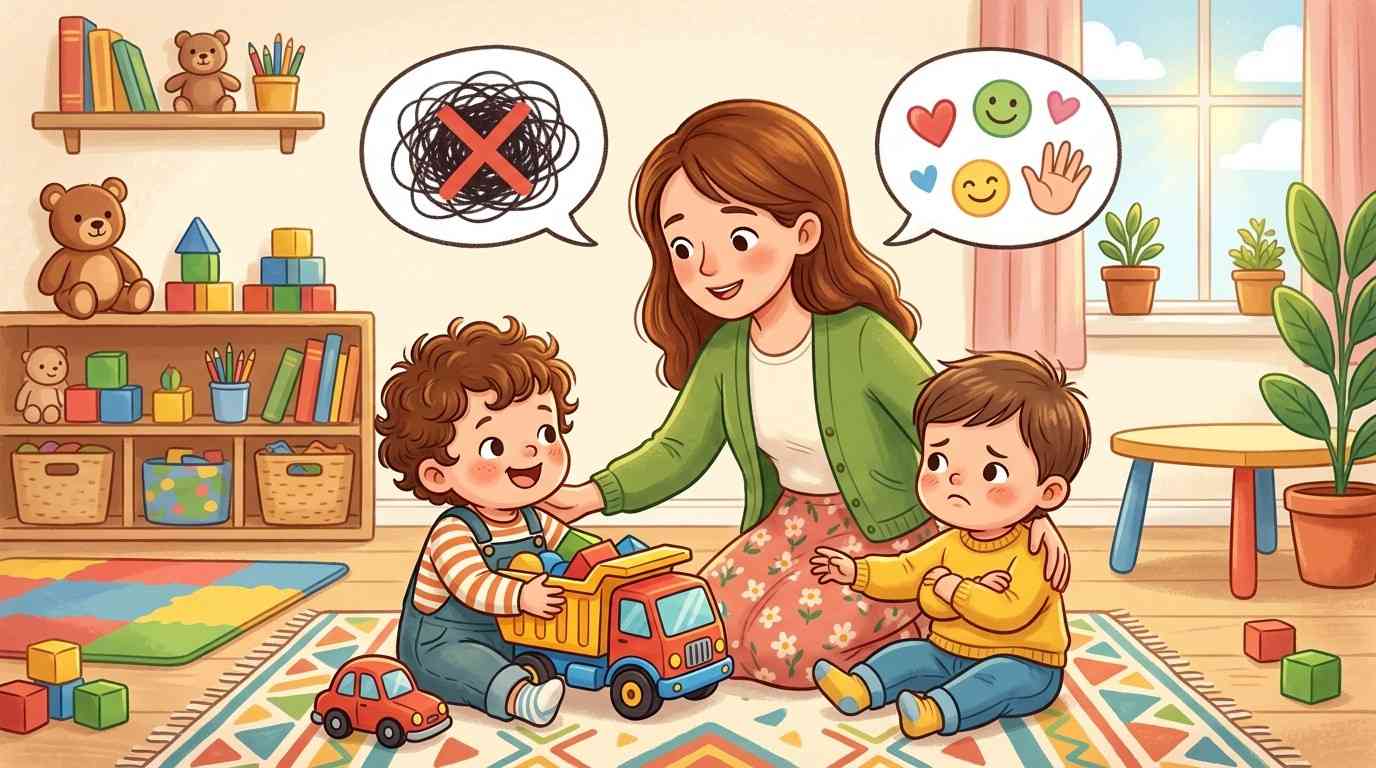
When two children clash over a toy or a perceived unfairness, resist the urge to immediately solve the problem. Instead, become a facilitator who helps each child understand the other’s perspective.
Start by acknowledging both children’s feelings: “You’re upset because you were playing with that truck. And you’re frustrated because you’ve been waiting a long time for a turn.” This validation calms the emotional intensity enough for problem-solving to begin.
Then guide perspective-taking: “How do you think she felt when the truck was grabbed? How do you think he felt watching you play for so long?” Finally, involve children in generating solutions: “What could we do so both of you feel okay?”
This process takes longer than simply declaring who gets the toy, but it builds skills children will use for life.
The Connection Between Empathy and Self-Regulation
Empathy and self-regulation develop together, each supporting the other. A child who can manage their own emotional reactions has more capacity to notice and respond to others’ emotions. A child who understands others’ perspectives has additional motivation to regulate their behavior.
Practice self-regulation through games requiring impulse control: freeze dance, red light/green light, Simon says. These activities strengthen the same prefrontal cortex regions involved in empathetic responding.
Teach simple calming strategies: belly breathing, counting to five, squeezing a stress ball. When children have tools for managing their own big feelings, they’re better equipped to stay present when others are struggling.
Creating an Empathetic Environment for Long-Term Success
The physical and social environment surrounding preschoolers either supports or undermines empathy development. Thoughtful environmental design reinforces the lessons taught through modeling and activities.
Classrooms and homes that foster empathy share certain characteristics. They include diverse books and toys representing different abilities, family structures, and cultural backgrounds. They display children’s artwork about feelings and kindness. They have cozy spaces where children can retreat when overwhelmed.
Routines matter too. Regular check-ins about feelings, consistent language around emotions, predictable responses to conflict: these create safety that allows empathetic behavior to flourish.
Track progress by noticing small shifts over time. Does your child spontaneously comment on others’ emotions more often? Do they suggest helping someone who’s struggling? Do they show curiosity about why someone might feel a certain way? These markers indicate growing empathetic capacity.
The work of teaching empathy during the preschool years pays dividends across a lifetime. Children who develop strong empathetic abilities become adolescents who maintain healthier friendships, adults who build stronger relationships, and community members who contribute to collective wellbeing. Every moment spent nurturing this capacity, whether through a carefully chosen book, a patient conversation during conflict, or simply modeling kindness in daily interactions, shapes the kind of person your child will become.