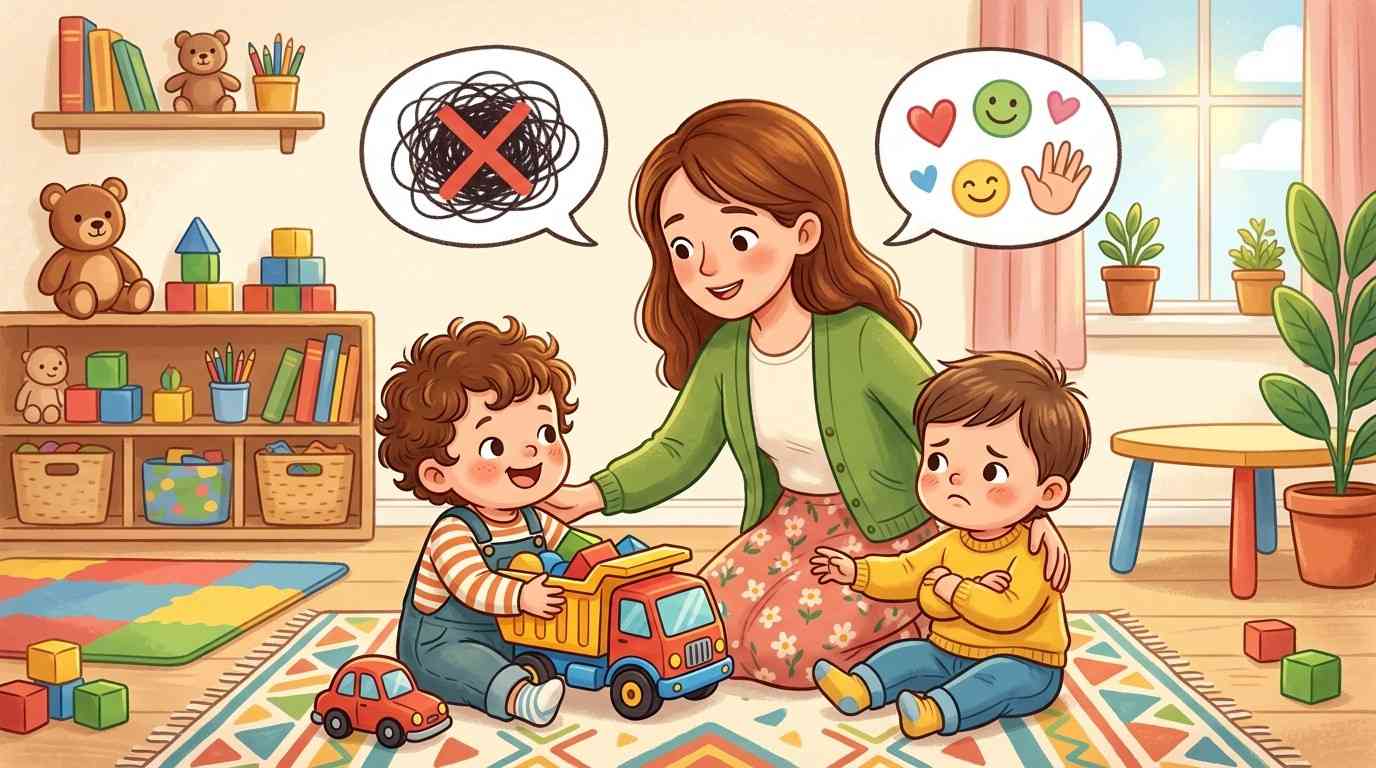
Every parent knows the scene: your toddler wants to read the same picture book for the fifteenth time this week, or they’re asking you to sing “Wheels on the Bus” while you’re still recovering from the last seven renditions. Your patience wears thin, but here’s the thing: your child’s brain is doing exactly what it’s supposed to do. That seemingly endless repetition isn’t a quirk or a phase to push through. It’s the primary mechanism through which young children build lasting knowledge, develop confidence, and wire their brains for future learning.
Understanding why repetition serves as the foundation for early childhood learning changes how we respond to these moments. Instead of redirecting children toward something new, we can recognize repeated requests as signs of active brain development. Research from developmental psychologists confirms what experienced early childhood educators have observed for decades: children don’t just tolerate repetition, they require it. Their brains are fundamentally different from adult brains, and those differences make repetition not just helpful but essential for encoding skills and information that will serve them throughout life.
The Science of Neural Pathways and Memory Consolidation
Young children’s brains contain roughly 100 billion neurons at birth, but the connections between those neurons are still being formed. Every experience a child has creates potential pathways, and repetition determines which pathways become permanent highways versus which fade into disuse. This process, called neural pruning, follows a simple principle: connections that fire together, wire together.
When a two-year-old practices stacking blocks repeatedly, they’re not just playing. They’re strengthening specific neural circuits that coordinate visual processing, motor control, and spatial reasoning. Each repetition adds another layer of myelin, the fatty coating that insulates neural pathways and speeds up signal transmission. The difference between a child who has practiced a skill ten times versus a hundred times is measurable in brain scans.
Strengthening Synaptic Connections Through Practice
Synapses, the gaps between neurons where information transfers, become more efficient with repeated activation. Researchers at Harvard’s Center on the Developing Child describe this as “serve and return” interactions building brain architecture. When a child repeats an action and receives consistent feedback, whether from a caregiver’s response or from the physical world, those synaptic connections strengthen.
The mechanism makes sense when you consider how different children’s brains are from adults’. Adult brains have already established efficient pathways for most basic skills. We don’t need to consciously think about forming letters when we write or maintaining balance when we walk. But children are building these pathways from scratch, and each repetition is like adding another strand to a rope that needs to hold weight.
Moving Information from Short-Term to Long-Term Memory
Working memory in young children is remarkably limited. A three-year-old can typically hold only one or two pieces of information in mind at once, compared to the four to seven items adults can manage. This constraint means children need many more exposures to move information from temporary storage into permanent memory.
The hippocampus, the brain region responsible for memory consolidation, processes repeated experiences during sleep and wakeful rest. Studies from the University of Sheffield found that infants who napped after learning new tasks showed significantly better retention than those who stayed awake. Repetition during the day provides the raw material, and sleep provides the processing time. Without sufficient repetition, there’s simply not enough material for the brain to consolidate.
Building Confidence and Mastery Through Familiarity
Beyond the neurological benefits, repetition serves crucial psychological functions for young children. The world is overwhelming when everything is new. Familiar activities and predictable patterns create islands of competence in a sea of uncertainty, allowing children to develop the confidence they need to eventually tackle novel challenges.
The Psychological Comfort of Predictable Patterns
Watch a child’s face when they correctly anticipate what comes next in a familiar story. That flash of recognition and satisfaction isn’t trivial: it’s the feeling of mastery, of understanding how something works. Developmental psychologist Laura Berk from Illinois State University has documented how this sense of predictability reduces stress hormones and creates optimal conditions for learning.
Children who feel secure in familiar routines show more willingness to explore new territory. The predictable becomes a home base from which they venture out. A child who knows exactly how bedtime unfolds, the same books, the same songs, the same sequence of events, can handle occasional variations without distress. The repetition hasn’t made them rigid; it’s given them a stable foundation.
Developing Self-Efficacy via Task Success
Self-efficacy, the belief in one’s ability to succeed, develops through accumulated experiences of success. For young children, those experiences need to be repeated many times before they solidify into genuine confidence. A child who successfully zips their jacket once might still doubt their ability the next day. A child who has done it fifty times knows they can do it.
This explains why children often want to demonstrate skills repeatedly, even after they’ve clearly mastered them. They’re not showing off; they’re reinforcing their own belief in their capabilities. Each successful repetition adds evidence to their internal narrative: I am someone who can do this.
Language Acquisition and the Power of Rhythmic Repetition
Language development provides perhaps the clearest example of why young children learn best through repetition. Children need to hear a word an average of fifty to one hundred times before it becomes part of their active vocabulary. That’s not a flaw in their learning system; it’s a feature that ensures words are properly mapped to meanings and sounds are correctly produced.
Phonemic Awareness and Vocabulary Retention
Phonemic awareness, the ability to hear and manipulate individual sounds in words, develops through repeated exposure to language patterns. Research from Vanderbilt University shows that children who hear more repetitive language, including songs, rhymes, and repeated phrases, develop stronger phonemic awareness than those exposed primarily to varied speech.
The repetition allows children to notice patterns they would miss with single exposures. Hearing “cat,” “hat,” and “bat” repeatedly helps a child recognize the rhyming pattern. Hearing “ball,” “baby,” and “big” repeatedly highlights the initial sound. These pattern recognitions form the foundation for later reading skills, and they require many, many exposures to develop.
The Role of Nursery Rhymes and Storytelling
Nursery rhymes have persisted across cultures and centuries not because adults enjoy them, but because children’s brains are specifically tuned to learn from them. The combination of rhythm, rhyme, and repetition creates ideal conditions for language encoding. Brain imaging studies show that rhythmic language activates motor regions alongside language areas, creating multiple memory pathways for the same information.
Repeated storytelling serves a similar function. When a child asks for the same story night after night, they’re processing it at deeper levels each time. First they grasp the basic plot, then character motivations, then vocabulary, then narrative structure. What looks like redundancy from an adult perspective is actually layered learning that wouldn’t happen with a different story each night.
Refining Motor Skills and Physical Coordination
Physical development follows the same repetition-based pattern as cognitive development. A child learning to catch a ball isn’t just practicing the catch itself; they’re calibrating visual tracking, timing, hand positioning, and grip strength. Each component requires separate repetition, and the integration of all components requires even more practice.
Motor learning researchers describe three stages: cognitive, associative, and autonomous. In the cognitive stage, children think consciously about each movement. Through repetition, they move to the associative stage, where movements become smoother but still require attention. Only after extensive practice do skills become autonomous, performed without conscious thought.
The number of repetitions required varies by complexity. Simple skills like clapping might become autonomous after dozens of repetitions. Complex skills like riding a bicycle require hundreds or thousands. Young children are simultaneously developing dozens of motor skills, and each one follows this repetition-dependent trajectory. The child who wants to go down the slide again and again isn’t being difficult; they’re in the associative stage, refining a skill that hasn’t yet become automatic.
Practical Strategies for Incorporating Repetition at Home
Understanding the science is one thing; applying it in daily life is another. Parents can support repetition-based learning without losing their minds to monotony. The key is recognizing which types of repetition matter most and finding ways to sustain them.
Balancing Routine with Novelty to Prevent Boredom
Children need repetition, but they also need appropriate challenge. The sweet spot lies in repeating core elements while varying peripheral details. Reading the same book can include different voices, pausing at different points, or asking different questions. Singing the same song can involve new hand motions or tempo changes.
Effective repetition strategies include:
- Keeping the same basic structure while changing surface features
- Letting children lead repetition choices rather than imposing them
- Adding one new element only after the base skill is solid
- Recognizing when genuine mastery has been achieved and new challenges are needed
The goal isn’t endless repetition of everything, but sufficient repetition of foundational skills. Once a child has truly mastered something, they’ll naturally lose interest and seek new challenges.
Utilizing Spaced Repetition for Better Learning Outcomes
Spaced repetition, distributing practice over time rather than massing it together, produces stronger long-term retention. This principle, documented extensively by researchers at the University of California San Diego, applies to children as well as adults. Ten minutes of practice daily beats an hour of practice once a week.
Parents can apply spaced repetition by returning to previously learned material periodically. The book that was a favorite three months ago, revisited now, reinforces learning while revealing how much the child has grown. Skills practiced intensively during one developmental period can be maintained with occasional practice sessions later.
Track your child’s learning informally by noting which skills are in active development versus which have become automatic. Active development skills benefit from daily repetition. Automatic skills need only occasional maintenance to remain strong.
The Long-Term Impact of a Solid Foundational Base
Children who receive adequate repetition during early development carry advantages throughout their educational careers. The neural pathways established through early repetition become the infrastructure for later learning. Strong phonemic awareness, built through repeated exposure to language patterns, predicts reading success years later. Motor skills refined through physical play support handwriting and sports participation. Confidence developed through mastery experiences encourages academic risk-taking.
The opposite pattern also holds. Children who are rushed through developmental stages without sufficient repetition often show gaps that surface later. A child who never fully automated letter recognition will struggle with reading fluency. A child who never developed secure attachment through predictable routines may have difficulty with emotional regulation.
Early childhood represents a unique window when the brain is maximally plastic and repetition is maximally effective. The same amount of practice that produces mastery in a four-year-old might require three times as much effort in a ten-year-old. This isn’t an argument for pushing academic content earlier, but rather for respecting the repetition-based learning that young children naturally seek.
When your toddler requests the same story for the twentieth time, consider what’s actually happening: a brain building itself, one repetition at a time. Your patience with that repetition isn’t just kindness; it’s an investment in neural architecture that will serve your child for decades. The science is clear: young children learn best through repetition because their brains are designed to learn that way. Our job is to provide the repeated experiences they need, even when we’re thoroughly tired of “Wheels on the Bus.”