The morning started with a meltdown over the wrong cereal bowl. Then came the battle about socks. By 8:15 AM, you’d already raised your voice twice, felt guilty about it, and wondered if you were somehow failing at this whole parenting thing.
Here’s what I wish someone had told me years ago: the difference between chaotic parenting and connected parenting isn’t about overhauling your entire approach. It’s not about reading twelve books or implementing some elaborate system. The families I’ve watched transform their dynamics did it through small, intentional shifts that created outsized results.
Parenting with intention doesn’t require perfection. It requires presence, awareness, and a willingness to make tiny adjustments that compound over time. Research from the Harvard Center on the Developing Child confirms what many parents intuitively sense: consistent, small positive interactions shape brain architecture more powerfully than occasional grand gestures. A study tracking 1,200 families found that parents who implemented just three intentional practices daily reported 47% higher satisfaction with family relationships within six months.
The shifts we’re talking about take seconds, not hours. They cost nothing. And they work because they address the root of disconnection rather than just managing symptoms. Whether you’re parenting a toddler navigating their first taste of autonomy or a teenager pushing boundaries, these principles adapt across ages and stages.
Defining the Intentional Parenting Framework
Most parents operate on autopilot more than they realize. We respond to situations based on how we were raised, our current stress levels, or whatever worked last time. Intentional parenting means creating a pause between stimulus and response, choosing how to engage rather than simply reacting.
The framework rests on three pillars: awareness of your own emotional state, clarity about your family’s core values, and consistent micro-decisions aligned with both. It sounds simple because it is. The challenge lies in execution when you’re exhausted, overwhelmed, or triggered.
Moving from Reactive to Proactive Responses
Reactive parenting looks like this: your child spills milk, you snap, they cry, you feel terrible, everyone’s morning is ruined. The trigger-response loop happens in milliseconds, leaving little room for choice.
Proactive parenting inserts a gap. Developmental psychologist Daniel Siegel calls this the “response flexibility” zone. When you feel that familiar surge of frustration, you take one breath before speaking. That single breath activates your prefrontal cortex and interrupts the amygdala hijack that leads to regrettable reactions.
Start tracking your reactive moments for one week. Note the time of day, your physical state, and the trigger. Most parents discover patterns: they’re more reactive when hungry, when running late, or during transitions. Once you identify your vulnerability windows, you can prepare differently. Eating breakfast before waking the kids might prevent three conflicts. That’s not indulgent self-care; it’s strategic parenting.
Identifying Your Core Family Values
Ask ten parents what they want for their children, and you’ll hear similar answers: happiness, success, kindness. But these abstract ideals don’t guide daily decisions. When your child refuses to share at a playdate, which value takes priority: their autonomy, your social comfort, or teaching generosity?
Sit down with your partner or co-parent and identify three to five specific values that matter most to your family. Not what should matter or what your parents valued, but what genuinely resonates with you. Maybe it’s creativity, honesty, resilience, connection, or adventure.
Write them down. Post them somewhere visible. When you face a parenting dilemma, filter your response through these values. If resilience tops your list, you might let your child struggle with a difficult puzzle rather than swooping in to help. The values become your decision-making compass.
The Power of Micro-Moments and Presence
Quality time has become a loaded phrase, conjuring images of elaborate outings and Pinterest-worthy activities. But research from UCLA’s Center on Everyday Lives of Families found that brief moments of genuine connection throughout the day matter more than occasional extended experiences.
Children spell love differently than adults. For them, love is spelled T-I-M-E, but not necessarily quantity. They need moments when they feel truly seen, when your attention is fully theirs.
The 10-Minute Undivided Attention Rule
Dr. Stanley Greenspan’s research on child development introduced the concept of “floor time,” but you don’t need to become a therapist to apply its principles. Commit to 10 minutes daily of completely undivided attention with each child. Phone in another room. No mental to-do lists. Just presence.
Let your child lead the activity. If they want to play with toy cars for the 47th consecutive day, play cars. Your job isn’t to educate or improve the play; it’s to join their world without agenda. This feels counterintuitive for achievement-oriented parents, but the connection built during child-led play deposits trust into your relationship bank account.
Track this practice for two weeks. Note your child’s behavior before and after these sessions. Most parents report decreased attention-seeking behaviors, fewer tantrums, and more cooperation within days. The mechanism makes sense when you think about it: children who feel securely connected don’t need to act out to confirm the relationship exists.
Active Listening as a Tool for Connection
Listening seems passive, but true active listening requires more energy than talking. It means setting aside your own thoughts, resisting the urge to fix or advise, and reflecting back what you hear.
When your child tells you about a conflict with a friend, try this: “It sounds like you felt really hurt when Maya didn’t want to play with you at recess. That’s a hard feeling.” Stop there. Don’t add “but I’m sure she’ll play with you tomorrow” or “maybe you could try asking someone else.”
Children process emotions through expression, not advice. When we jump to solutions, we inadvertently communicate that their feelings are problems to be solved rather than experiences to be understood. The validation itself often resolves the emotional charge, and then they’re ready to problem-solve on their own.
Reframing Daily Routines into Rituals
Routines are tasks you complete. Rituals are meaningful moments you create. The activities might look identical from the outside, but the internal experience differs dramatically.
Brushing teeth can be a nightly battle or a silly bonding moment with made-up songs. The difference lies in your intention and presence during the activity.
Intentional Morning and Bedtime Transitions
Transitions are when most family conflict erupts. The shift from sleep to wakefulness, from home to school, from play to bed, these liminal moments trigger resistance because they require children to leave one state and enter another.
Design your morning routine backward from your departure time, building in 15 extra minutes. Use that buffer not for additional tasks but for connection. Maybe it’s a two-minute snuggle before getting out of bed, or a quick dance party while packing backpacks. The specific activity matters less than the intention behind it.
Bedtime rituals deserve particular attention. Research from the University of Rochester found that consistent, calming bedtime routines improved sleep onset by an average of 20 minutes and reduced nighttime waking by 37%. But beyond sleep benefits, bedtime offers a unique opportunity for emotional intimacy. The darkness and physical closeness create safety for conversations that wouldn’t happen at the dinner table.
Using Shared Meals for Emotional Check-ins
Families who eat together regularly show better outcomes across nearly every measure: academic performance, emotional regulation, reduced risk-taking in adolescence. But simply occupying the same space while eating doesn’t capture the benefit. The magic happens through conversation.
Create a simple structure for mealtime connection. Some families use “rose, thorn, bud,” where each person shares something good, something difficult, and something they’re looking forward to. Others ask creative questions: “What made you laugh today?” or “Who did you help today?”
The structure matters less than the consistency. Children come to expect and anticipate these moments of family connection. Over time, they internalize the message that their inner lives interest you, that their daily experiences deserve attention and discussion.
Small Shifts in Communication and Language
The words we choose shape our children’s self-concept and their understanding of the world. Small linguistic shifts can transform the emotional climate of your home.
Replacing ‘No’ with Positive Redirection
Children hear “no” hundreds of times daily. By age two, it’s often their most-used word. While boundaries remain essential, constant negation creates a restrictive atmosphere and triggers automatic resistance.
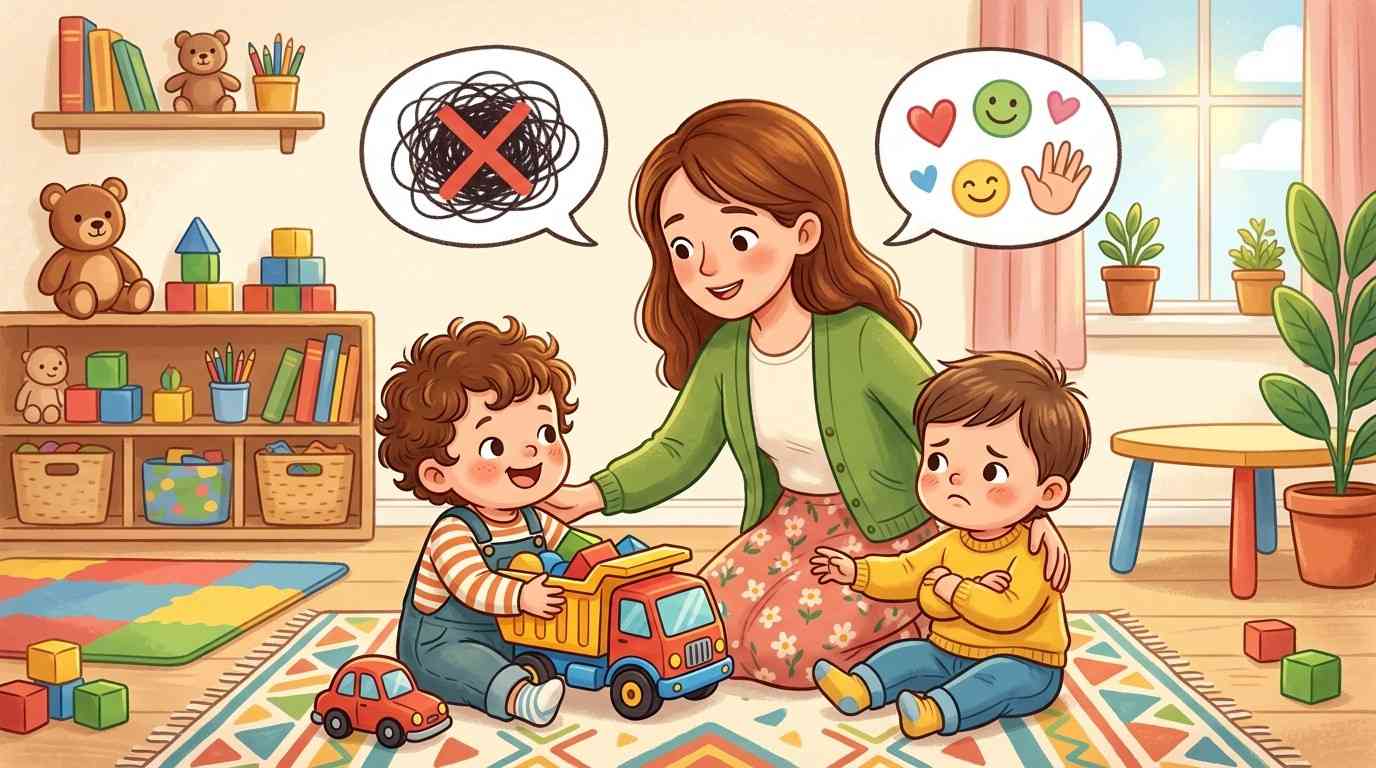
Instead of “No running inside,” try “Walking feet inside, please.” Rather than “Don’t hit your sister,” try “Gentle hands with your sister.” The behavior expectation stays the same, but you’re telling the child what to do rather than what not to do.
This isn’t about permissiveness. It’s about communication efficiency. The brain processes positive instructions more easily than negative ones. When you say “Don’t think about a pink elephant,” what happens? The same principle applies to children’s behavior. Telling them what you want makes compliance neurologically easier.
Validating Emotions Before Problem-Solving
Here’s a pattern that derails countless parent-child interactions: child expresses emotion, parent immediately offers solution, child escalates or shuts down.
The fix requires patience but not much time. Before any advice, suggestion, or perspective, validate the emotion. “You’re really frustrated that we can’t go to the park.” “You’re disappointed that your friend canceled.” “You’re angry that I said no to more screen time.”
Validation doesn’t mean agreement. You can validate your child’s anger about a limit while maintaining the limit. The acknowledgment of their emotional experience communicates respect and builds emotional vocabulary. Children who learn to name their feelings develop better self-regulation because they can identify internal states rather than being overwhelmed by them.
Cultivating Emotional Intelligence Through Modeling
Children learn emotional regulation primarily through observation. They watch how you handle frustration, disappointment, and conflict. Your modeling teaches more than any lecture or consequence.
Practicing Self-Regulation in Stressful Moments
When you feel yourself escalating, narrate your internal process aloud. “I’m feeling really frustrated right now. I need to take some deep breaths before I respond.” This accomplishes two things: it models healthy coping, and it buys you time to actually calm down.
Identify your personal calm-down strategies and practice them visibly. Maybe you step outside for 30 seconds, splash water on your face, or do shoulder rolls. When children see you using tools to manage big feelings, they learn that emotions are manageable, not emergencies.
Research from Vanderbilt University found that children whose parents modeled emotional regulation strategies showed 40% better self-regulation by age five compared to peers whose parents simply instructed them to calm down. The difference between showing and telling is substantial.
The Impact of Vulnerability and Admitting Mistakes
Parenting culture often emphasizes authority and consistency, creating pressure to appear infallible. But admitting mistakes models something crucial: that errors are survivable, that relationships can repair, and that growth requires acknowledging when we fall short.
When you lose your temper, circle back later. “I yelled at you this morning, and that wasn’t okay. I was stressed about being late, but that’s not your fault. I’m sorry.” This repair process teaches children that ruptures in connection aren’t permanent, that taking responsibility matters, and that apologies are signs of strength.
Children of parents who model healthy repair show better conflict resolution skills in their own relationships. They learn that disagreement doesn’t mean disconnection, and that accountability strengthens rather than weakens bonds.
Sustaining Progress and Embracing Imperfection
The biggest obstacle to intentional parenting isn’t lack of knowledge; it’s the expectation of perfection. You’ll forget your values, react poorly, and miss opportunities for connection. This doesn’t mean you’ve failed. It means you’re human.
Track your progress through simple metrics: count the number of reactive moments daily, note how many minutes of undivided attention you provided, or rate your evening connection on a 1-10 scale. Looking back over weeks reveals patterns and progress that single days obscure.
Build in weekly reflection, even just five minutes. What worked? What triggered you? What do you want to try differently? This brief review prevents autopilot from taking over again.
The goal isn’t a perfect family but a connected one. Children don’t need flawless parents; they need present ones who keep trying, who repair when they mess up, and who prioritize relationship over compliance. Small shifts, practiced consistently, create the big impact you’re hoping for. Start with one change this week. Notice what happens. Adjust and continue. Your intentional parenting journey begins with your next interaction.