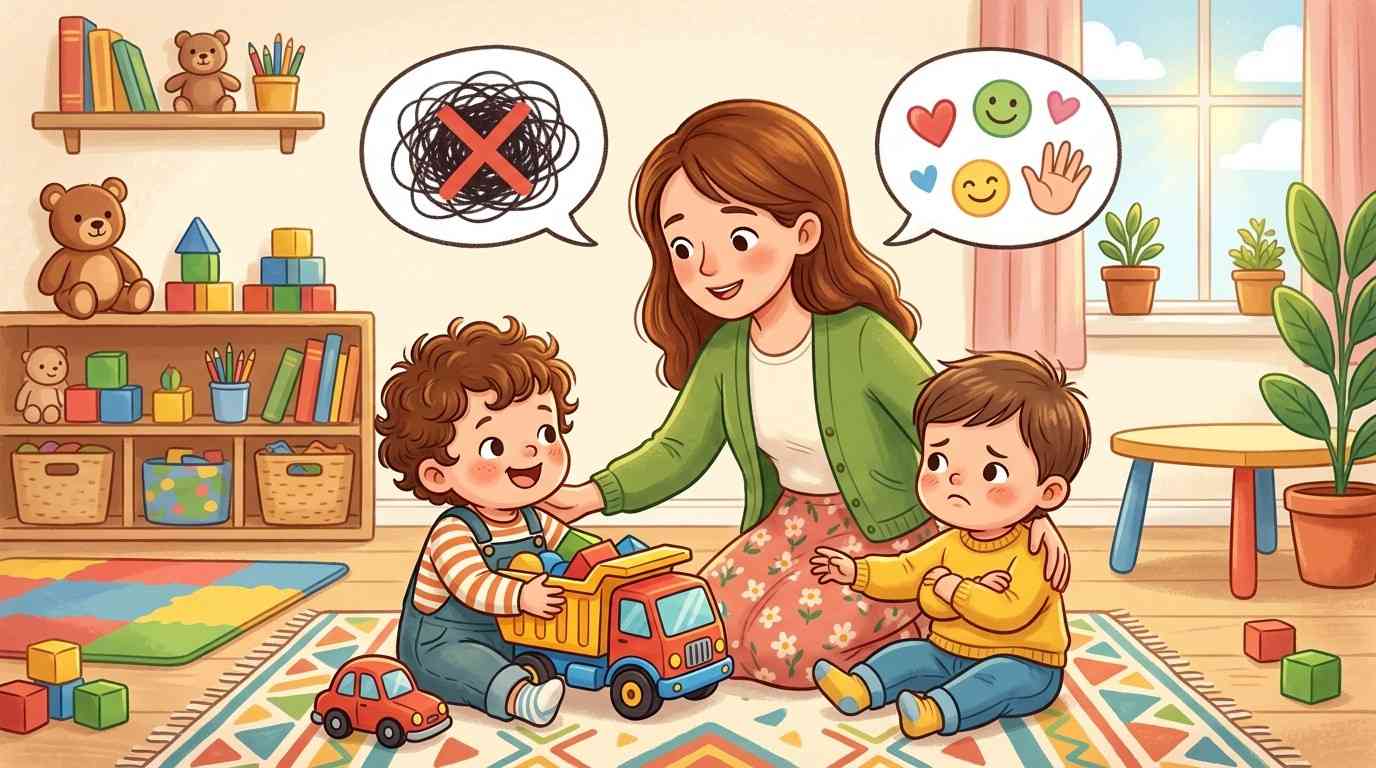
Babies often stare, smile, touch, and giggle at their own reflection in mirrors. That fascination seems simple, but it’s actually a window into important cognitive and social development. Mirrors help infants explore motion, recognition, and emotion; they also offer caregivers a natural, playful tool for supporting early self-awareness milestones.
What mirror fascination reveals about infant development
When infants look into a mirror they are engaging multiple skills at once: visual tracking, attention regulation, motor planning, and basic social interaction. At first, the mirror is another interesting stimulus—shiny, moving, and responsive. Over time, mirror play becomes a testing ground for whether the image maps onto their own body and actions.
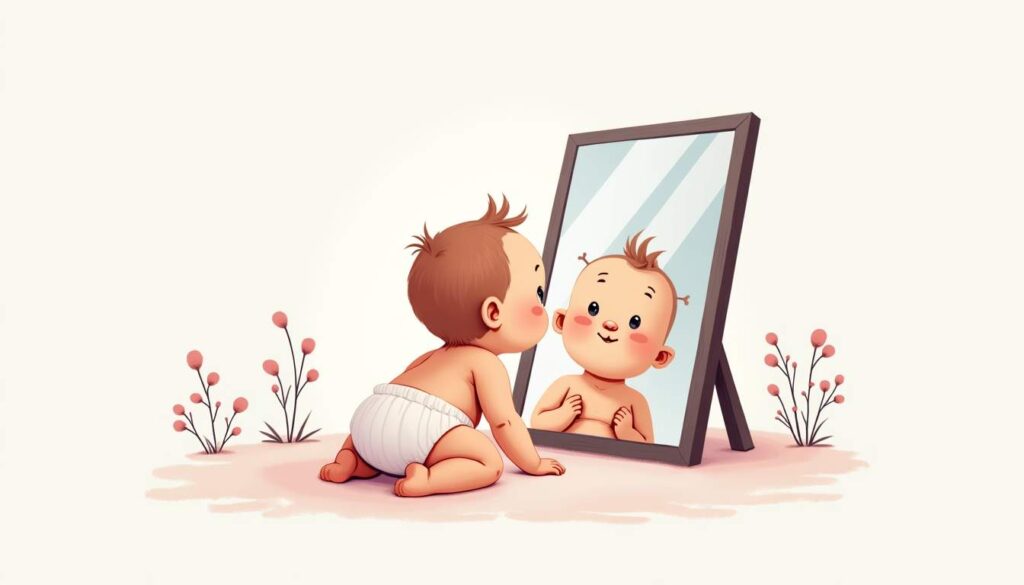
Watching a reflected face moving in synchrony with their own actions teaches infants about cause and effect. That synchronous feedback helps them learn that their gestures and expressions can produce predictable outcomes in the environment, a key building block for later intentional behavior and social understanding.
From reflexes to recognition
Newborns primarily respond to high-contrast patterns and faces. Their “interest” in a mirror may begin as a visual attraction to contours and motion rather than true self-recognition. As sensorimotor skills mature, the infant becomes more able to connect the mirror image with internal sensations and physical movements.
By around 6 months, infants often begin to show increased curiosity, reaching toward the mirror and sometimes making exaggerated movements to elicit responses from the reflected image. This exploratory behavior indicates a growing awareness of the link between their own actions and what they observe, a precursor to the development of a sense of self.
Moreover, caregivers can facilitate this developmental process by engaging with the infant during mirror play, providing social cues such as smiles and vocalizations. These interactions not only enhance the infant’s attention and emotional connection but also help scaffold their emerging understanding of social reciprocity and self-other differentiation.
Typical timeline: mirror reactions by age
Infant reactions to mirrors evolve in recognizable stages. Each child progresses at a different pace, but the general pattern offers a helpful guide for caregivers who want to understand what a baby is experiencing at different ages.
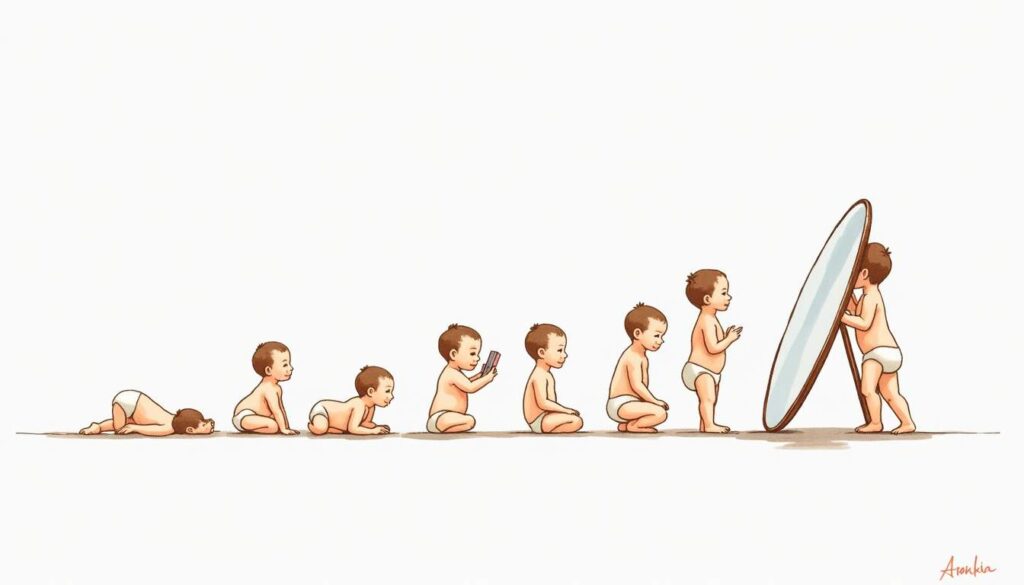
0–3 months: visual exploration and social smiles
During the first months, attention is drawn to faces, bright contrasts, and moving objects. Babies may stare at their reflection, follow movement, and smile at faces—whether real or reflected. These behaviors reflect early social responsiveness and visual preference, not self-recognition.
4–8 months: interest increases and motor testing begins
By mid-infancy, stronger motor control and hand-eye coordination allow babies to reach toward mirrors, pat the surface, or tap the frame. Interaction with the mirror often includes vocalizations and amused expressions. The reflection becomes a playful partner for practicing new skills.
9–18 months: emerging self-awareness
This period is where more sophisticated developments occur. Infants begin to understand that the person in the mirror is related to themselves. They may look behind the mirror or use it to inspect hidden body parts. Many babies start to show signs of recognizing themselves in the second year of life.
18–24 months: classic self-recognition appears
The milestone commonly associated with mirror self-recognition—reacting to a mark placed on the face—often emerges around 18 to 24 months. When a toddler notices the mark in a mirror and attempts to touch it on their own face, that indicates a concrete understanding of self as an entity separate from others.
The “mirror test” explained and its limits
The mirror test, developed in the 1970s, uses a visible mark placed on the subject’s face to assess whether they recognize themselves in a mirror. If the child touches the mark on their own face after seeing it in the mirror, researchers take that as evidence of self-recognition.
Though useful, the mirror test has limits. Motivation matters: some children might see the mark but not care enough to touch it. Cultural factors and novelty effects also influence performance. Moreover, self-awareness is multidimensional and unfolds over time, so failure on this one task does not mean a lack of self-understanding.
Other ways self-awareness shows up
Self-awareness includes body awareness, agency (understanding actions have effects), and social identity. Toddlers demonstrate agency when they repeat actions that caused interesting outcomes, and they show body awareness when moving to avoid obstacles or pointing to body parts. These behaviors often appear before passing the mirror test.
Why mirrors are great tools for learning
Mirrors provide immediate visual feedback, which accelerates learning about movement and expression. They let babies observe their own smiles, frowns, and gestures from a third-person perspective—helping to build a sense of continuity between internal feelings and external appearance.
Mirrors also support language development. Caregivers can narrate what a baby is doing in the mirror, label body parts, and imitate expressions. This responsive interaction strengthens vocabularies and helps link words to actions or emotions.
Social and emotional benefits
Looking at faces—even reflected ones—encourages social engagement. A baby who sees their own happy face may repeat the expression, reinforcing positive social feedback loops. Mirror play is also a safe way for toddlers to experiment with emotional expressions and practice empathy by recognizing similar expressions in others.
Practical mirror activities for different ages
Introducing mirrors in age-appropriate ways can maximize learning while keeping interactions entertaining and safe. Small changes in how mirrors are used can make a big difference in what a baby gets out of the experience.
Newborns to 6 months
Keep a small, lightweight baby-safe mirror close during tummy time. Let the infant watch the reflection as they move their head and kick. Sing and make simple faces to encourage look-and-repeat sequences. These activities help build visual tracking and social responsiveness.
6 to 12 months
Place a mirror near seated playtime so the infant can reach and pat the reflection. Offer toys that can be used in front of the mirror to link object exploration with self-observation. Encourage vocalizations and respond to the baby’s sounds to build conversational back-and-forth.
12 to 24 months
Use a standing mirror or a larger wall-mounted mirror (securely fastened) so toddlers can explore full-body movement. Play games that invite imitation—make a funny face and ask the child to copy. Point to body parts in the mirror and use simple labels: “nose,” “hands,” “belly.” When the child notices a sticker or a washable dot on their face, celebrate the discovery and name the action.
Safety and practical considerations
Not all mirrors are appropriate for babies. Choose mirrors designed for infants—unbreakable, shatterproof, and with no sharp edges. Secure larger mirrors firmly to the wall or use adhesives made for childproofing to prevent tipping hazards.
Clean mirrors often. Babies explore with their hands and mouths, so keeping the surface free from smears and germs reduces the risk of skin irritation or illness.
Where to place mirrors
Position mirrors at floor level for tummy time and crawling, and at standing height as toddlers begin to pull up and walk. Mirrors in play areas should be stable and out of reach of heavy objects that could fall. Avoid placing mirrors near changing tables or high surfaces where an infant could climb and risk a fall.
When to be curious, and when to consult a professional
Most babies follow a wide range of typical development when it comes to mirror interest and self-recognition. If a baby shows no interest in faces, avoids eye contact, or seems unusually unresponsive to social interaction for several months, it may be worth discussing with a pediatrician to rule out vision issues or developmental concerns.
Delays in mirror self-recognition alone are rarely a sign of significant problems, because self-awareness emerges gradually and is influenced by many factors. Still, persistent social withdrawal, little reaction to caregivers’ faces, or concerns about hearing and language should prompt professional advice.
Cultural variations and caregiving practices
Different cultures use mirrors and reflective surfaces in unique ways, and not all societies emphasize mirror exposure in early childhood. In some communities, infants may see fewer mirrors but gain similar self-awareness through social interaction, play, and caregiving routines. Mirror play is just one reliable pathway among many that promote self-understanding.
Caregivers who do not use mirrors frequently can still support self-awareness by narrating activities, encouraging imitation, and offering opportunities for the child to observe their own actions—through water play, shadow play, or by looking into polished surfaces like metal bowls.
Inclusivity and sensory differences
Children with sensory-processing differences or visual impairment may respond differently to mirrors. For visually impaired infants, tactile and auditory cues provide alternate routes to self-awareness. For sensory-sensitive children, mirrored surfaces can sometimes be overstimulating; gradual, guided exposure may help.
Troubleshooting common mirror-play problems
Some babies become startled or upset when seeing a mirror image for the first time. Calming reassurance and gentle, predictable games help reduce fear. Others may obsessively tap the mirror or use it as a chew surface—redirecting to mirror-safe toys or placing the mirror slightly out of reach encourages healthier interaction.
When mirror play seems too intense
If a child becomes fixated on the mirror to the exclusion of other play for extended periods, introduce structured variety. Offer new toys, books, or outdoor time to broaden stimulation. If fixation persists and interferes with daily routines, bring concerns to a pediatrician or child development specialist.
Final thoughts: mirrors as playful bridges to self-understanding
Mirrors are more than just shiny objects; they act as interactive tools that support a baby’s journey toward recognizing body, emotions, and agency. Through simple, responsive play with mirrors, caregivers can nurture attention, language, and social skills in ways that feel natural and fun.
Encouraging mirror exploration—safely and sensitively—lets infants experiment with movement and expression while building the foundations of self-awareness that will support future learning and social relationships. The reflections seen today are the first steps toward a growing sense of self and connection with others.